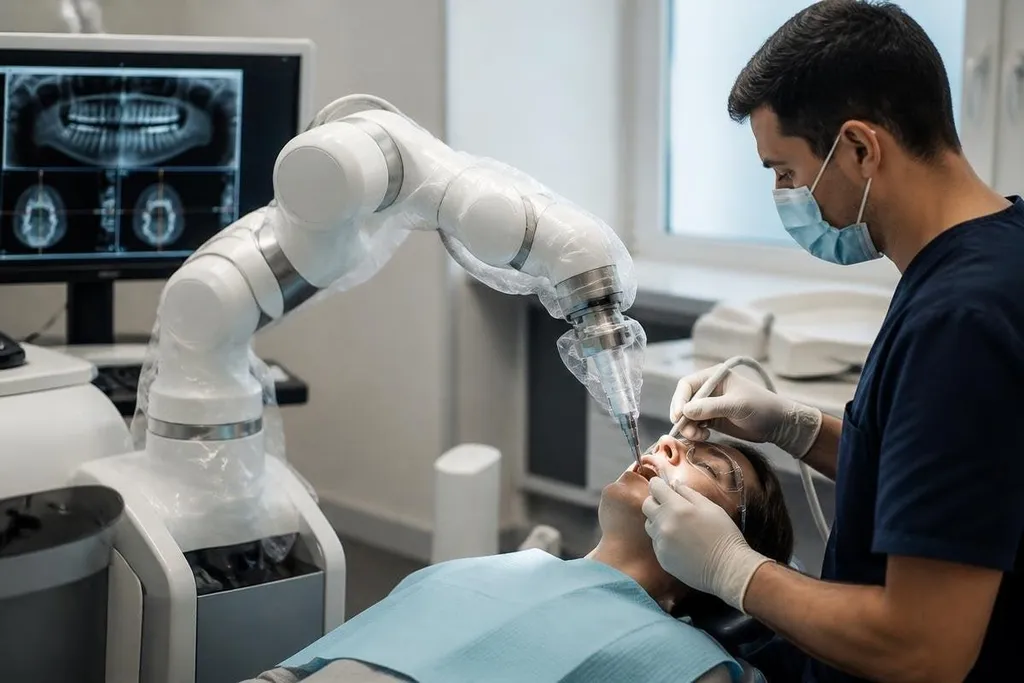
A dental robot can hold a drill, guide an implant, or move a tool along a planned path. The appeal is clear: repeatable motion in a small working area. The risk is just as clear: a small error near a nerve or artery can cause lasting harm.
- Robots can steady tool movement during tightly planned procedures.
- Imaging and software still decide much of the robot’s path.
- A dentist must remain responsible for setup, monitoring, and patient care.
Where dental robots can help
Dental work often demands controlled movement inside a narrow space. A robotic arm can follow a pre-set path while a dentist watches the site and stops the system when conditions change.
This may help with implant placement, where the planned position depends on bone shape, implant angle, and nearby anatomy. A robot can also hold a tool in a fixed position during tasks that would otherwise depend on a person’s hand staying steady for a long period.
That benefit has limits. The robot does not decide what the patient needs. A scan, treatment plan, and set of safety limits guide its motion, so a poor plan can still produce a poor result.
The role of imaging and software
Dental robots depend on more than motors. They may use cone-beam computed tomography, or CBCT, to create a 3D view of the jaw. Planning software then marks the treatment area and sends movement instructions to the robot.
The chain matters because each step can add error. A scan may not match the patient’s position during treatment. The bite may shift. A guide may move. Software may also need a dentist to check whether the planned route fits the real anatomy.
A treatment robot’s safety case depends on more than a smooth scan or guided drill. Dental robotics reporting from Robot24.com can place the task, control limits, and clinical evidence beside each claim, so you can see what the dentist still has to approve.
A dentist still needs to confirm the scan, check the plan, position the patient, and watch the tool. In a safe setup, the robot carries out a limited task under human control rather than working alone.
The main risks
The first risk is planning error. If the scan, reference point, or surgical guide is wrong, accurate robot movement can send the tool to the wrong place.
The second risk is a change in the patient. Movement, bleeding, swelling, or limited mouth opening can make the original plan less useful. A robot that follows its path without detecting that change needs a clear stop process.
There are also practical risks. The practice needs staff who can set up the system, check its sensors, clean the equipment, and respond to a fault.
A device that takes too long to prepare may reduce the number of patients a clinic can treat, even if the movement itself is precise. That can affect the value of the system before a dentist sees any gain in treatment quality.
Training matters too. Dentists must know when to use the robot and when to return to a manual method. Patients also need a plain explanation of what the system does, what the dentist controls, and what happens if the robot stops.
What to check before buying or booking
A clinic should answer these questions before it presents dental robotics as a reason to choose treatment:
- Defined task: Which part of the procedure does the robot perform?
- Human control: Can the dentist stop motion at once?
- Scan check: Who confirms that the image matches the patient’s position?
- Failure plan: What happens after a sensor, software, or power fault?
- Clinical proof: Which published results support this exact device and procedure?
- Patient cost: Does the robot change the treatment price or only the clinic’s equipment list?
These checks separate a useful tool from a sales claim. A clinic may have a robot without having enough evidence to show that it improves results for every patient.
I’d treat dental robots as controlled tools, not as replacements for dental judgment.
What happens next
The useful question is not whether a robot looks precise. It is whether scanning, treatment, and follow-up together give patients better results with no added risk.
Until clinics publish clear results for specific procedures, patients should ask what the robot does, who controls it, and what evidence supports its use.